Showing posts with label spirituality of trees. Show all posts

Tuesday, February 28, 2012

Yew: Tree of Death...wood grain to die for


Photo © Penny Mayes (cc-by-sa/2.0)
In the USA, we tend to think of yew as a shrub. I have a few in the landscaping around my house. Actually, these are probably a dwarf variety of Japanese Yew. In Europe, especially the United Kingdom, the yew grows as a tree, and has been growing there for thousands of years. The 5000 year old “Ice Man” mummy discovered in the Alps, had a bow and an axe handle made of yew wood. The yew tree is ancient, magical and mystical. It is probably the most interesting tree type on the planet.

The botanical name for the yew tree is taxus baccata. The Latin word taxus is from the Greek “taxon” which means “bow”. For millenniums, yew wood has been used for long bows, and still is today. Most parts of the yew tree are poisonous and thus it is often called the “Tree of Death”. Shakespeare acknowledged yew as a poison in both Macbeth and Hamlet.  In mythology and Celtic tradition, the yew is associated with dark goddesses. It is the tree of winter. Go to any New Age, Celtic folklore or Wicca website and you will find enormous amounts of information on the mystical nature of the yew tree. One very informative one is White Dragon.
 
Tree of death, but also a tree associated with rebirth since the yew sends up new shoots from its roots.  This may be why, throughout the British Isles, old yew trees are found in grave yards near churches.  The interesting fact is that, in most cases, the old yew tree near an ancient church predates the church itself.  In many cases, the trees are older than the date that Christianity was introduced to the region.  Some have recently been scientifically verified to be over 2,000 years old.  It is believed that the early Christian churches and cemeteries were built on the site of old Celtic holy places and burial grounds where the sacred yew tree already existed.


Box in yew wood by James Baxendale
The wood from the yew tree is known for its beautiful grain patterns.  Even though it is classified as an evergreen, yew wood is very dense and hard.  The tree grows very slowly and has tight growth rings.  Objects made out of yew wood have a naturally hard and smooth finish.  A lot of sanding with fine grit sandpaper is often unnecessary.

Artwork in yew wood by Edric Florence


My own pocket boxes with compass made out of yew wood
There is so much to write about the yew tree that I could fill volumes.  For instance: It is a fact that a new cancer curing drug called Taxol has been derived from the bark and berries of the yew tree (Tree of Death or Tree of Life?).  Or the fact that, even though vast yew forests once covered many parts of ancient Europe, the yew is an endangered species today.  Then there are the pictures by Archie Miles, who is on a quest to photograph all the spectacular and interesting trees of Britain, including many yews. You will enjoy his website.

Photo of yew wood grain by Archie Miles

Tuesday, December 20, 2011

Christmas Traditions, Symbolism, Religious Tolerance…and Trees and Wood

At this time of year, it seems that anyone who can type words on a keyboard gets involved with controversial issues. Some Christians say that Christmas is really a pagan holiday. I’m amazed by how much is written on the internet regarding this subject. These anti-Christmas Christians say that the holiday is based on the Roman festival of Saturnalia and the Celtic Yule and the Winter Solstice. They say that the Christmas Tree itself comes from the Babylonian pagan Nimrod, whose followers believed that, on his birthday, December 25th, an evergreen tree would spring forth from a stump and bear presents. “Not so”, say other Christians. The Christmas Tree tradition comes from the Paradise Tree used in the old mystery plays of 16th century Germany. A play was performed on December 24th, the feast day of Adam and Eve, and the tree represented the tree from the Garden of Eden. It was adorned with red apples and later small white wafers to symbolize the Eucharist, the body of Christ. These apples and wafers gradually evolved into fruits and cookies and then into the ornaments we see today. And what about St. Boniface. Supposedly he cut down the Tree of Thor in the German town of Geismar in the early 700’s. Later a fir tree grew among the roots of the old oak. He is reported to have said: “Let Christ be the center of your households and use the fir tree as a symbol of Christianity.” Now I’m really confused.


Ah, but just calling it a “Christmas Tree” can be offensive to some other religions, so in 2005 the city of Boston renamed the spruce tree used to decorate the Boston Common a "Holiday Tree" rather than a "Christmas Tree". The name change drew a poor response from the public and was changed back to "Christmas Tree" after the city was threatened with several lawsuits.

If the Christmas Tree is considered to be pagan by some Christians, you can just imagine what they think about the Yule log. Burned at the time of the Winter Solstice to welcome the return of the Sun God, it has roots in Nordic, Celtic and Roman religions. In Slavic traditions, the log is called Badnjak, and it has become part of a totally Christian ritual. In both the Roman Catholic Croatian tradition and the Orthodox Serbian tradition, an oak log is cut with great ceremony on Christmas Eve morning and then brought into the house. There are elaborate prayers and blessings tying the symbolism of the burning log with the coming of Christ. The Serbian tradition includes priests burning oak saplings on a large fire in the public square. It’s interesting to consider that both sides in the Bosnian Conflict during the 1990’s must have celebrated the same Christmas Eve religious tradition while they were trying to kill each other. Sort of like the Germans and the Allies singing Silent Night together across the trenches during World War 1.

Orthodox priest places the badnjak on the fire during Christmas Eve celebration.
Wood and trees indeed play an important part in many Christmas traditions. But what does it all mean? Should we really use fuzzy historical details and twisted logic to segregate our beliefs from those of others? This special time of year is too wonderful to separate ourselves into “us and them”. Can’t we all just join hands, dance around the tree, or sit around the fire and focus on all that we have in common rather than the few things that separate us? Can’t we just celebrate in peace? Jesus, the Prince of Peace, would like that, I’m sure.

I wish you all a very Merry Christmas!


Sunday, December 11, 2011

Colorful Carved Coffins of Ghana

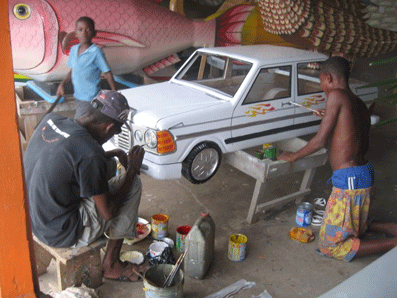
http://www.ghana-net.com/fantasy-coffins-of-ghana---fantasie-saerge-in-ghana
In one of my previous posts, I talked about wood carving in Ghana.  There is another important expression of wood craftsmanship in Ghana that should also be mentioned.  I’m talking about hand-crafted wooden burial coffins, in the shape of everything from a Coke bottle to a Mercedes.  This colorful art form is unique to Ghana.

For most tribal cultures in Ghana, especially the Ga people from around Accra, funerals are not only a time of mourning, but also a time of celebration.  They can last a week with food and music and every relative and friend in attendance.  The people believe that their departed loved one is moving to another life, and they make sure they do it in style.

In the 1960’s a creative carpenter named Seth Kane Kwei started making custom designed fantasy coffins which were called Abebuu adekai (" boxes with proverbs ") by Ga people.  The concept became very popular and the construction of these coffins is still carried on today by relatives and former apprentices of Kwei in a number of wood shops scattered around southern Ghana.  The coffins are designed to represent an important aspect of the deceased person’s life.  It may be a taxi cab, if the person was a driver; or a fish if the person was a fisherman.  It may be symbolize the person’s hobby, pet or even a vice like a bottle of beer or a cigarette. 


The coffins are custom-made and can take up to three weeks to complete.  During that time the deceased person is kept in a refrigerated morgue.  Most coffins are usually made from a light, inexpensive wood such as wawa or alstonia boonei (cheese wood).


These special coffins are works of art, built by skilled carpenters; designed and finished by talented wood artists. Unlike many works of wood art that remain visible for centuries; these wood creations are buried with the deceased, never to be seen again. It is truly art for the moment, transitory art, like Tibetan Buddhist sand paintings. Each coffin is returned to the same earth that nourished the original tree which gave the wood to build the coffin. The cycle is complete.


The concept of hand-worked wood returning to the earth is the same for any wooden coffin, whether it is Ghana or an old cemetery here in the United States. The wood decays in the ground and a new tree grows, but the skill of the wood craftsman remains constant through all generations.


Not Ghana, but the Moravian Cemetery, Bethlehem, PA


Tuesday, October 25, 2011

Wood Carving in Ghana


"I am coming to cut you down and carve you, receive this egg and eat…do not let the iron cut me, do not let me suffer in health.
…a prayer said by a carver to the spirit of the tree.
Documented by Prof. R.S. Rattray in a thesis “Religion and Art in Ashanti” (1927)

my souvenirs
Many years ago, I had the opportunity of spending a week in Accra, Ghana on business.  Like a typical tourist, I brought back a few carved wooden souvenirs. Not until recently did I become aware of the extent of woodcarving in Ghana and its importance to the economy of the country.

Wood carving is done throughout Ghana, but it is mostly centered in the Ashanti region just north of Accra.  The small villages of Aburi and Ahwiaa are mentioned often on the web as wood carving centers.  The wood carving tradition was always an important part of the culture of  the ethnic Akan people who, for centuries, have occupied all of Ghana and part of the Ivory Coast.

modern Ghana sculpture
Today, Ghanaian wood carvers produce an endless variety of figurines and plaques for the tourist trade, or for export to other countries.  Some are cleverly designed with modern African figures and animals.  If you go back 100 years or more, however, you wouldn’t see such individual creativity.  In the old days, carving was done as a communal, not individual, form of expression.  Deviation from community accepted standards and designs was tabooed.  Carving was done under the strict direction of clan leaders, and was totally done by men.  Not every man carved.  The carvers were seen as a privileged minority endowed with special skills from God.  They even had their own secret initiation rituals for apprentices.

carving a djembe drum
The traditional Ghanaian carved wood items include: drums, masks, (Akuaba) fertility dolls, mortars and stools. All these items are still made and exported today.   The form and design of these items has changed very little over the years.
an Ashanti stool
The stools are a topic by themselves.  They were a symbol of status among the tribal leaders and can also be a carved record of maternal genealogy. They are carved from a single piece of wood.  The seat part is curved and represents the warm embrace of a mother. The center middle section contains symbols that indicate the owner’s beliefs, history or values. Most stools had an Adinkra symbol on the front.  These symbols were also stenciled on cloth. They are used today on many handicraft items.  Most modern Ghanaians know the meanings of each Adrinka symbol. The symbol on the stool in the photo above is called Gye Nyame, or "except for God", and indicates the supremacy of God.
carving stools
Since ancient times, trees in Ghana were considered dwelling places of supernatural spirits and powers, both benevolent and malevolent.  The trees felled for carving were given certain ritual purification rites.  When a carver acquired a new set of tools, the tools had to be pacified to solicit good and cordial relations from the spirits.  Strong alcoholic drinks were poured on the tools and special libation prayers were offered.  (See an excerpt from a prayer at the top.) 
In Ghana, the primary woods used in carving are Sese (Holarrhena wulfsbergii) and Tweneboa (Cordia millenii). The tweneboa is a sacred tree.  Its name literally means "drum tree".  It is relatively soft and easy to carve and sometimes already hollow, which makes it ideal for drum making.  Most Kpanlogo drums are made from tweneboa.  Other woods used include: Afromosia, Mahogonay, Odum “Iroko”, Cedrela and Sinuro.
a young carver
The wood carvers in Ghana today work 10 hours a day, 7 days a week. They make their own tools out of iron and steel and keep them very sharp. Do a video search on-line for “Ghana wood carvers” and you will see some amazing carving with simple tools, and no fancy vises or fixtures. I especially like the drum carving video.
The information in this post was obtained from various sources on the web including an informative report entitled "Carving Tradition in Ghana", by the Ghana Natinal Commission for UNESCO.

Tuesday, April 26, 2011

Spirit in the Wood

“…The tree, which is used for the body of the drum, contains a living spirit. Great care is taken to make sure that the wood of the drum is alive.” 
from: “The Beat of My Drum: An Autobiography” by Babatunde Olatunji

Ask my family. Most of my adult life I have wanted a hand drum. That might seen to be an unusual desire coming from a retired white guy in the suburbs, but it was an itch that just wouldn’t go away. At first I thought I wanted a conga drum. Then I attended a drum circle where they had an assortment of African drums to use for the evening. Most of the drums were djembes, the familiar West African style drum, but a few were different. They were taller, had a slightly different shape and a much deeper, richer sound. They are called bougarabou, a bit of onomatopoeia, since the drum name is the sound it makes (bou-gara-bou). I immediately knew what type of drum I wanted. It was a perfect fit for my baritone soul.


Last week I finally got my drum. I love it. I bought it from a shop called “Spirit in the Wood”. With a name like that, how could I do otherwise? Spirit in the Wood is a small, one-man operation. That man is Conrad Kubiak, a professional drummer, drum teacher and drum maker. Conrad is an interesting character. He may be a reincarnation of Leonardo DaVinci. He works out of a small house with detached garage/workshop, on a small road in rural Bucks County, PA. There is no sign and most people would just pass it by. Most people, yes, but any person who works with wood would notice the collection of hefty log sections sitting in his driveway, especially since half of them have large, interesting-looking burls on them, waiting to be turned into works of art.


There is no doubt that Conrad is a wood craftsman. Just like all other wood turners, Conrad has a lathe. The only difference is that while some turners make pens, Conrad makes conga drums. He turns his own drum shells on a monster industrial lathe that must be 100 years old, and takes up half of his workshop. He has personally developed special tooling and techniques that sets his craft apart.

Sure he makes high quality drums out of fine hardwoods, but if you look closely on the dusty shelves you will also fine beautiful bowls turned out of burl and fine crafted wooden boxes that will be magnificent, if he ever gets to finish them. Conrad knows drums, and he also knows wood.


My bougarabou drum


I bought my drum from Conrad, but not one of his hand-crafted works of art. Since this is my "beginner’s” drum, I bought one that was hand carved out of iroko wood by a craftsman in the Ivory Coast, a genuine West African drum. But who knows? If I get good, maybe I’ll upgrade to one of his eye-popping cherry wood originals.
Saturday, January 16, 2010

The Wild Horses of Newbury

I firmly believe in the spirituality of trees. I can’t explain what it all means, it’s just that trees have been revered as sacred living things longer than we have been worshiping as Christians. There must be something to it. I believe that making beautiful or utilitarian objects out of the wood from trees gives them a new life after they have been cut down. I also believe that too many old growth trees are being cut down.

My recent research all started with the movie “Avatar”. (Great movie. Go see it in 3D.) In the movie, the great “Tree of Souls” is destroyed by the ruthless and greedy exploiters of the mineral resources of the planet. There is enough symbolism here to keep a discussion group busy for months. This giant tree is analogous to Yggdrasil, the great Tree of Life in Norse mythology.

Researching Yggdrasil I came across the website of an interesting music group from England called Moksha (see: http://www.mokshaproductions.com/.) (More on Moksha some other time.) Moksha’s website links to a video called: The Wild Horses of Newbury, which just blew my mind. It’s about the unexplainable spirituality of the old trees, a spirituality that we as a modern, progressive society, just can’t comprehend. Go to: http://video.google.com/videoplay?docid=4171383607583139639 . Watch this video and tell me what you think.

Wednesday, September 16, 2009

The Green Man Revisited

It has been about 5 years since I carved the Green Man. I became captivated by the whole Green Man mystery when I saw my first Green Man in Chris Pye's book "Elements of Woodcarving". Visit his website at: http://chrispye-woodcarving.com/index.html. Chris is a great woodcarver and his books have taught me a lot about woodcarving. He has a page on his website devoted to the the Green Man with links to other sites. There are many theories on what the symbol of the Green Man means and why the symbol appears in so many medieval churches. No one knows for sure, where the symbolism comes from, or why he was so ubiquitous during that period.

Some people think it is purely a pagan symbol. Personally, I think it is simply a symbol of re-birth which may have roots in pagan beliefs, but has been absorbed and transformed to represent Christian beliefs, like Easter and Resurrection.

I am quickly approaching retirement age, and a new phase of my life. Seeing the Green Man hanging in my living room reminds me that my passage into retirement should be a re-birth into a new life of creativity and appreciation of nature.

Have you ever carved a Green Man? What do you think the Green man symbol means?