In my search for interesting symbols to carve on recycled wooden cigar boxes, I discovered Japanese crests. These crests, also called mon, or in the case of family crests, kamon, have been an important element in Japanese design for centuries. Their history and usage throughout the ages is an interesting subject. I will not go into the history in this posting, but you can do your own research on the internet. The crest symbols were originally used by the samurai and powerful warlord families. Today they are used primarily as decorative symbols for fabrics, tattoos, and corporate logos. The three diamond Mitsubishi logo for example, seen on all their vehicles, is actually the family crest. It symbolically represents three water chestnuts.
I started by getting a good reference book which shows hundreds of Japanese crest patterns and variations. Certain designs are perfect for carving; others are not. Some crests, even though very beautiful, are just too detailed and intricate to carve in wood. Some crests are very dramatic and impressive; others are rather mundane.
Most representations of the mon symbols are seen as two dimensional impressions on paper, fabric or skin. Carving them into wood presented some problems with proportions and spacing because of the depth dimension and sloped edges. Also, in the two dimensional representations, there is almost always an important contrast of positive and negative spaces…usually dark printing on a light background. Showing this contrast in uniformly colored wood required some added steps. I wound up using dark background stains and pyrography.
Despite these challenges, I was able to find a few crest designs that seemed to lend themselves to carving on the top of a wooden box. Three are shown in the photo above. Have you ever used Japanese crests in your work?
Wednesday, August 8, 2012
Thursday, June 14, 2012
The Back Porch Project
I have not posted on this blog for quite some time now. There are a number of reasons for this, one of which is spring. Spring always brings an abundance of thing to do, mostly outdoors and away from my workshop. There is yard clean-up, planting and lawn maintenance. I haven’t been doing any small woodworking projects; instead I have been totally consumed by one big one. I built a new wooden back porch.
| Before |
This project took a long time to complete, far longer than I had imagined. A good friend of mine told me that when you have a project like this, you should figure out how much time it will take to finish it; then double the estimate…then multiply by ten. He was not far from wrong.
The end result is not perfect, but it is functional and looks good. I learned a few things from this project. First, I learned that words like “level” and “square”, which I always thought were absolutes, turn out to be suggested goals. I learned that driver screws and metal corner brackets result in an unbelievably strong construction. The porch could probably support an elephant. I learned that wet wood shrinks after it dries. This should not have been a surprise to a wood person like me, but I learned the hard way. The 1/8” gaps between the decking boards are now ¼” gaps. Finally, I learned not to be a perfectionist.
| After |
Labels:
miscellaneous,
woodworking
Tuesday, February 28, 2012
Yew: Tree of Death...wood grain to die for
![]() |
| Photo © Penny Mayes (cc-by-sa/2.0) |
In the USA, we tend to think of yew as a shrub. I have a few in the landscaping around my house. Actually, these are probably a dwarf variety of Japanese Yew. In Europe, especially the United Kingdom, the yew grows as a tree, and has been growing there for thousands of years. The 5000 year old “Ice Man” mummy discovered in the Alps, had a bow and an axe handle made of yew wood. The yew tree is ancient, magical and mystical. It is probably the most interesting tree type on the planet.
Tree of death, but also a tree associated with rebirth since the yew sends up new shoots from its roots. This may be why, throughout the British Isles, old yew trees are found in grave yards near churches. The interesting fact is that, in most cases, the old yew tree near an ancient church predates the church itself. In many cases, the trees are older than the date that Christianity was introduced to the region. Some have recently been scientifically verified to be over 2,000 years old. It is believed that the early Christian churches and cemeteries were built on the site of old Celtic holy places and burial grounds where the sacred yew tree already existed.
![]() |
| Box in yew wood by James Baxendale |
The wood from the yew tree is known for its beautiful grain patterns. Even though it is classified as an evergreen, yew wood is very dense and hard. The tree grows very slowly and has tight growth rings. Objects made out of yew wood have a naturally hard and smooth finish. A lot of sanding with fine grit sandpaper is often unnecessary.
There is so much to write about the yew tree that I could fill volumes. For instance: It is a fact that a new cancer curing drug called Taxol has been derived from the bark and berries of the yew tree (Tree of Death or Tree of Life?). Or the fact that, even though vast yew forests once covered many parts of ancient Europe, the yew is an endangered species today. Then there are the pictures by Archie Miles, who is on a quest to photograph all the spectacular and interesting trees of Britain, including many yews. You will enjoy his website.
![]() |
| Artwork in yew wood by Edric Florence |
| My own pocket boxes with compass made out of yew wood |
![]() |
| Photo of yew wood grain by Archie Miles |
Thursday, January 19, 2012
A More Manly Cigar Box Transformation
I was getting tired of carving flowers into empty wooden cigar boxes and transforming them into jewelry boxes and tea caddies. I needed to make something more manly; something a man could appreciate. I wound up making a box for my son-in-law for Christmas. A woman puts her “stuff” in a jewelry box. A man puts his “stuff” into a…valet box, or utility box, or something. I guess it doesn’t have an official name.

The design is a Celtic snake which is an adaptation of a tattoo design. That’s manly. I call it the Snake Box…very manly. The cigar box is made in Honduras using sapele wood, which is native to Africa. Sapele is pretty nice to carve, sort of like mahogany, but it can get splintery in spots. You also might run into hard knotty areas and irregular grain patterns. Most of the side pieces of these cigar boxes are made of quarter sawn sapele which usually shows a brilliant ray pattern.
I made the interior trays entirely from wood from other scrap cigar boxes. The sides are Spanish cedar and the bottoms are thin plywood. It is not shown here, but I left the cigar manufacturer’s imprinting and brand on wood on the bottom of the trays. It sort of keeps a connection with the original use as a cigar box. It says “Made in Honduras” and “Hecho a Mano”. I added small wooden feet, which helps the transformation from an ordinary cigar box to handsome valet box.
I used a maroon felt with an alligator skin pattern, adding to the manly look. The top tray slides back and forth over the bottom tray to expose or hide the bottom compartments.
If, like me, you are tired of carving flowers, find a Celtic tattoo pattern and carve something manly.
Labels:
box making,
old cigar boxes,
types of wood,
wood carving
Tuesday, December 20, 2011
Christmas Traditions, Symbolism, Religious Tolerance…and Trees and Wood
At this time of year, it seems that anyone who can type words on a keyboard gets involved with controversial issues. Some Christians say that Christmas is really a pagan holiday. I’m amazed by how much is written on the internet regarding this subject. These anti-Christmas Christians say that the holiday is based on the Roman festival of Saturnalia and the Celtic Yule and the Winter Solstice. They say that the Christmas Tree itself comes from the Babylonian pagan Nimrod, whose followers believed that, on his birthday, December 25th, an evergreen tree would spring forth from a stump and bear presents. “Not so”, say other Christians. The Christmas Tree tradition comes from the Paradise Tree used in the old mystery plays of 16th century Germany. A play was performed on December 24th, the feast day of Adam and Eve, and the tree represented the tree from the Garden of Eden. It was adorned with red apples and later small white wafers to symbolize the Eucharist, the body of Christ. These apples and wafers gradually evolved into fruits and cookies and then into the ornaments we see today. And what about St. Boniface. Supposedly he cut down the Tree of Thor in the German town of Geismar in the early 700’s. Later a fir tree grew among the roots of the old oak. He is reported to have said: “Let Christ be the center of your households and use the fir tree as a symbol of Christianity.” Now I’m really confused.
Ah, but just calling it a “Christmas Tree” can be offensive to some other religions, so in 2005 the city of Boston renamed the spruce tree used to decorate the Boston Common a "Holiday Tree" rather than a "Christmas Tree". The name change drew a poor response from the public and was changed back to "Christmas Tree" after the city was threatened with several lawsuits.
If the Christmas Tree is considered to be pagan by some Christians, you can just imagine what they think about the Yule log. Burned at the time of the Winter Solstice to welcome the return of the Sun God, it has roots in Nordic, Celtic and Roman religions. In Slavic traditions, the log is called Badnjak, and it has become part of a totally Christian ritual. In both the Roman Catholic Croatian tradition and the Orthodox Serbian tradition, an oak log is cut with great ceremony on Christmas Eve morning and then brought into the house. There are elaborate prayers and blessings tying the symbolism of the burning log with the coming of Christ. The Serbian tradition includes priests burning oak saplings on a large fire in the public square. It’s interesting to consider that both sides in the Bosnian Conflict during the 1990’s must have celebrated the same Christmas Eve religious tradition while they were trying to kill each other. Sort of like the Germans and the Allies singing Silent Night together across the trenches during World War 1.
Ah, but just calling it a “Christmas Tree” can be offensive to some other religions, so in 2005 the city of Boston renamed the spruce tree used to decorate the Boston Common a "Holiday Tree" rather than a "Christmas Tree". The name change drew a poor response from the public and was changed back to "Christmas Tree" after the city was threatened with several lawsuits.
If the Christmas Tree is considered to be pagan by some Christians, you can just imagine what they think about the Yule log. Burned at the time of the Winter Solstice to welcome the return of the Sun God, it has roots in Nordic, Celtic and Roman religions. In Slavic traditions, the log is called Badnjak, and it has become part of a totally Christian ritual. In both the Roman Catholic Croatian tradition and the Orthodox Serbian tradition, an oak log is cut with great ceremony on Christmas Eve morning and then brought into the house. There are elaborate prayers and blessings tying the symbolism of the burning log with the coming of Christ. The Serbian tradition includes priests burning oak saplings on a large fire in the public square. It’s interesting to consider that both sides in the Bosnian Conflict during the 1990’s must have celebrated the same Christmas Eve religious tradition while they were trying to kill each other. Sort of like the Germans and the Allies singing Silent Night together across the trenches during World War 1.
Labels:
spirituality of trees
Sunday, December 11, 2011
Colorful Carved Coffins of Ghana
![]() |
http://www.ghana-net.com/fantasy-coffins-of-ghana---fantasie-saerge-in-ghana
|
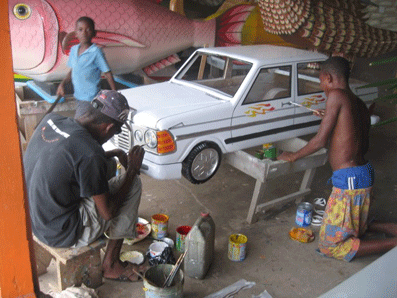
In one of my previous posts, I talked about wood carving in Ghana. There is another important expression of wood craftsmanship in Ghana that should also be mentioned. I’m talking about hand-crafted wooden burial coffins, in the shape of everything from a Coke bottle to a Mercedes. This colorful art form is unique to Ghana.
For most tribal cultures in Ghana, especially the Ga people from around Accra, funerals are not only a time of mourning, but also a time of celebration. They can last a week with food and music and every relative and friend in attendance. The people believe that their departed loved one is moving to another life, and they make sure they do it in style.
In the 1960’s a creative carpenter named Seth Kane Kwei started making custom designed fantasy coffins which were called Abebuu adekai (" boxes with proverbs ") by Ga people. The concept became very popular and the construction of these coffins is still carried on today by relatives and former apprentices of Kwei in a number of wood shops scattered around southern Ghana. The coffins are designed to represent an important aspect of the deceased person’s life. It may be a taxi cab, if the person was a driver; or a fish if the person was a fisherman. It may be symbolize the person’s hobby, pet or even a vice like a bottle of beer or a cigarette.
The coffins are custom-made and can take up to three weeks to complete. During that time the deceased person is kept in a refrigerated morgue. Most coffins are usually made from a light, inexpensive wood such as wawa or alstonia boonei (cheese wood).
These special coffins are works of art, built by skilled carpenters; designed and finished by talented wood artists. Unlike many works of wood art that remain visible for centuries; these wood creations are buried with the deceased, never to be seen again. It is truly art for the moment, transitory art, like Tibetan Buddhist sand paintings. Each coffin is returned to the same earth that nourished the original tree which gave the wood to build the coffin. The cycle is complete.
The concept of hand-worked wood returning to the earth is the same for any wooden coffin, whether it is Ghana or an old cemetery here in the United States. The wood decays in the ground and a new tree grows, but the skill of the wood craftsman remains constant through all generations.
![]() |
| Not Ghana, but the Moravian Cemetery, Bethlehem, PA |
Labels:
Ghana,
spirituality of trees,
wood carving,
wood sculpture,
woodworking
Saturday, November 26, 2011
Good Wood
| Alpha Box cherry, redwood lace burl, and mahogany trim |
If you have been reading my blog, you must realize that most of the wood I use in my creations is found wood. The old silver maple tree that was cut down in the back yard several years ago has provided many spalted maple boxes and spoons. The apple tree provided a nice walking stick. And the trunk of the huge old cedar shrub was cut into pieces for many different projects. Call me cheap, but I hardly ever spend money to buy "good wood".
During last year’s excursion to a woodworking expo, I was tempted by a wood vendor with beautiful wood for sale. I succumbed to the temptation and purchased some good wood. I bought some nice cherry planks and a small, expensive piece of redwood lace burl. I planned on making my first constructed box using those power tools in my workshop that make very loud intimidating whining sounds. I’m talking about the table saw and the router table. These tools demand a certain respect since they can change your anatomy and send you to the emergency room in the blink of an eye. Up until now I have been using less harmful tools, like a small band saw, a drill press and carving gouges. These tools also require careful use, but they are nowhere near as fearful as the hungry rotating blade of the table saw.
I read books on box making, and I used some of the suggestions in the books, but as usual, I found my own ways of doing things. I took my time, and measured carefully. I’m pretty pleased with the result, which I named the Alpha Box. Of course there are several small flaws that are probably hardly noticeable to most people, but seem very obvious to me.
I learned that I still have a lot yet to learn about finishing wood. I learned that setting the hinges takes more time than building the pyramids. And I learned spending some money on good wood really improves the overall look of even my first attempt at a constructed box.
Labels:
box making,
types of wood,
woodworking
Subscribe to:
Posts (Atom)