
Showing posts with label Ghana. Show all posts

Sunday, December 11, 2011

Colorful Carved Coffins of Ghana

http://www.ghana-net.com/fantasy-coffins-of-ghana---fantasie-saerge-in-ghana
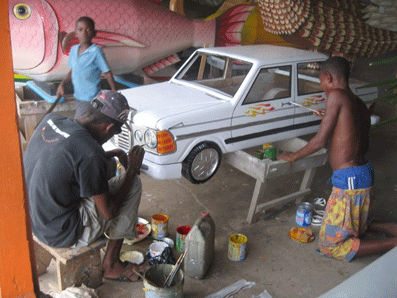
In one of my previous posts, I talked about wood carving in Ghana.  There is another important expression of wood craftsmanship in Ghana that should also be mentioned.  I’m talking about hand-crafted wooden burial coffins, in the shape of everything from a Coke bottle to a Mercedes.  This colorful art form is unique to Ghana.
For most tribal cultures in Ghana, especially the Ga people from around Accra, funerals are not only a time of mourning, but also a time of celebration.  They can last a week with food and music and every relative and friend in attendance.  The people believe that their departed loved one is moving to another life, and they make sure they do it in style.

In the 1960’s a creative carpenter named Seth Kane Kwei started making custom designed fantasy coffins which were called Abebuu adekai (" boxes with proverbs ") by Ga people.  The concept became very popular and the construction of these coffins is still carried on today by relatives and former apprentices of Kwei in a number of wood shops scattered around southern Ghana.  The coffins are designed to represent an important aspect of the deceased person’s life.  It may be a taxi cab, if the person was a driver; or a fish if the person was a fisherman.  It may be symbolize the person’s hobby, pet or even a vice like a bottle of beer or a cigarette. 


The coffins are custom-made and can take up to three weeks to complete.  During that time the deceased person is kept in a refrigerated morgue.  Most coffins are usually made from a light, inexpensive wood such as wawa or alstonia boonei (cheese wood).


These special coffins are works of art, built by skilled carpenters; designed and finished by talented wood artists. Unlike many works of wood art that remain visible for centuries; these wood creations are buried with the deceased, never to be seen again. It is truly art for the moment, transitory art, like Tibetan Buddhist sand paintings. Each coffin is returned to the same earth that nourished the original tree which gave the wood to build the coffin. The cycle is complete.


The concept of hand-worked wood returning to the earth is the same for any wooden coffin, whether it is Ghana or an old cemetery here in the United States. The wood decays in the ground and a new tree grows, but the skill of the wood craftsman remains constant through all generations.


Not Ghana, but the Moravian Cemetery, Bethlehem, PA


Tuesday, October 25, 2011

Wood Carving in Ghana


"I am coming to cut you down and carve you, receive this egg and eat…do not let the iron cut me, do not let me suffer in health.
…a prayer said by a carver to the spirit of the tree.
Documented by Prof. R.S. Rattray in a thesis “Religion and Art in Ashanti” (1927)

my souvenirs
Many years ago, I had the opportunity of spending a week in Accra, Ghana on business.  Like a typical tourist, I brought back a few carved wooden souvenirs. Not until recently did I become aware of the extent of woodcarving in Ghana and its importance to the economy of the country.

Wood carving is done throughout Ghana, but it is mostly centered in the Ashanti region just north of Accra.  The small villages of Aburi and Ahwiaa are mentioned often on the web as wood carving centers.  The wood carving tradition was always an important part of the culture of  the ethnic Akan people who, for centuries, have occupied all of Ghana and part of the Ivory Coast.

modern Ghana sculpture
Today, Ghanaian wood carvers produce an endless variety of figurines and plaques for the tourist trade, or for export to other countries.  Some are cleverly designed with modern African figures and animals.  If you go back 100 years or more, however, you wouldn’t see such individual creativity.  In the old days, carving was done as a communal, not individual, form of expression.  Deviation from community accepted standards and designs was tabooed.  Carving was done under the strict direction of clan leaders, and was totally done by men.  Not every man carved.  The carvers were seen as a privileged minority endowed with special skills from God.  They even had their own secret initiation rituals for apprentices.

carving a djembe drum
The traditional Ghanaian carved wood items include: drums, masks, (Akuaba) fertility dolls, mortars and stools. All these items are still made and exported today.   The form and design of these items has changed very little over the years.
an Ashanti stool
The stools are a topic by themselves.  They were a symbol of status among the tribal leaders and can also be a carved record of maternal genealogy. They are carved from a single piece of wood.  The seat part is curved and represents the warm embrace of a mother. The center middle section contains symbols that indicate the owner’s beliefs, history or values. Most stools had an Adinkra symbol on the front.  These symbols were also stenciled on cloth. They are used today on many handicraft items.  Most modern Ghanaians know the meanings of each Adrinka symbol. The symbol on the stool in the photo above is called Gye Nyame, or "except for God", and indicates the supremacy of God.
carving stools
Since ancient times, trees in Ghana were considered dwelling places of supernatural spirits and powers, both benevolent and malevolent.  The trees felled for carving were given certain ritual purification rites.  When a carver acquired a new set of tools, the tools had to be pacified to solicit good and cordial relations from the spirits.  Strong alcoholic drinks were poured on the tools and special libation prayers were offered.  (See an excerpt from a prayer at the top.) 
In Ghana, the primary woods used in carving are Sese (Holarrhena wulfsbergii) and Tweneboa (Cordia millenii). The tweneboa is a sacred tree.  Its name literally means "drum tree".  It is relatively soft and easy to carve and sometimes already hollow, which makes it ideal for drum making.  Most Kpanlogo drums are made from tweneboa.  Other woods used include: Afromosia, Mahogonay, Odum “Iroko”, Cedrela and Sinuro.
a young carver
The wood carvers in Ghana today work 10 hours a day, 7 days a week. They make their own tools out of iron and steel and keep them very sharp. Do a video search on-line for “Ghana wood carvers” and you will see some amazing carving with simple tools, and no fancy vises or fixtures. I especially like the drum carving video.
The information in this post was obtained from various sources on the web including an informative report entitled "Carving Tradition in Ghana", by the Ghana Natinal Commission for UNESCO.