Showing posts with label types of wood. Show all posts

Saturday, August 30, 2014

C. F. Martin & Co. Guitars - Fine Wood Craftsmanship in America


I visited the C. F. Martin & Co. guitar manufacturing plant in Nazareth, PA and took the factory tour. I was very impressed and also very surprised.  For some dumb reason I had expected to see a tiny woodshop with talented luthiers using hand tools, producing a few guitars a day.  Martin Guitar certainly has talented luthiers using hand tools, many with over 30 years of experience; but this all takes place within a humongous factory that uses modern production machinery to produce several hundred guitars per day.  Sure, they use laser cutting of the wood and robots for the final sanding and polishing, but the important woodcraft, all fitting and forming, is still done proudly by hand.
I observed one craftsperson fitting the guitar neck into the body. To me, it looked like a nice tight fit, but it was obviously not up to Martin Guitar standards, or her own personal standards as a luthier.  She tapped the neck out and used a very sharp chisel to shave a tiny, paper-thin slice from each side surface. She then gave it another dry fitting before gluing. It was now perfect.  It makes me feel good to see that exacting wood craftsmanship can still exist in such a high production environment.


The guitar tops are almost always made of spruce.  The sides and back of the guitars is where the “wow” factor comes in.   Martin Guitar uses beautifully grained hardwoods like walnut, tiger maple, mahogany, sapale and rosewood.  Just gorgeous.


Many of Martin guitars are custom made and have special mother of pearl inlays.  Laser assisted, but the final inlay and fitting work is all done by hand.

 
If you are a serious guitar player, the Martin Guitar factory with its spectacular guitar museum is like Mecca to Moslems or Vatican City to Catholics.  I don’t have to tell you about it.  You’ve probably been there already.  If you are a wood crafter or love objects made from wood, I would recommend that you go out of your way to visit this place and take the tour.  It’s very impressive.
 

Tuesday, February 28, 2012

Yew: Tree of Death...wood grain to die for


Photo © Penny Mayes (cc-by-sa/2.0)
In the USA, we tend to think of yew as a shrub. I have a few in the landscaping around my house. Actually, these are probably a dwarf variety of Japanese Yew. In Europe, especially the United Kingdom, the yew grows as a tree, and has been growing there for thousands of years. The 5000 year old “Ice Man” mummy discovered in the Alps, had a bow and an axe handle made of yew wood. The yew tree is ancient, magical and mystical. It is probably the most interesting tree type on the planet.

The botanical name for the yew tree is taxus baccata. The Latin word taxus is from the Greek “taxon” which means “bow”. For millenniums, yew wood has been used for long bows, and still is today. Most parts of the yew tree are poisonous and thus it is often called the “Tree of Death”. Shakespeare acknowledged yew as a poison in both Macbeth and Hamlet.  In mythology and Celtic tradition, the yew is associated with dark goddesses. It is the tree of winter. Go to any New Age, Celtic folklore or Wicca website and you will find enormous amounts of information on the mystical nature of the yew tree. One very informative one is White Dragon.
 
Tree of death, but also a tree associated with rebirth since the yew sends up new shoots from its roots.  This may be why, throughout the British Isles, old yew trees are found in grave yards near churches.  The interesting fact is that, in most cases, the old yew tree near an ancient church predates the church itself.  In many cases, the trees are older than the date that Christianity was introduced to the region.  Some have recently been scientifically verified to be over 2,000 years old.  It is believed that the early Christian churches and cemeteries were built on the site of old Celtic holy places and burial grounds where the sacred yew tree already existed.


Box in yew wood by James Baxendale
The wood from the yew tree is known for its beautiful grain patterns.  Even though it is classified as an evergreen, yew wood is very dense and hard.  The tree grows very slowly and has tight growth rings.  Objects made out of yew wood have a naturally hard and smooth finish.  A lot of sanding with fine grit sandpaper is often unnecessary.

Artwork in yew wood by Edric Florence


My own pocket boxes with compass made out of yew wood
There is so much to write about the yew tree that I could fill volumes.  For instance: It is a fact that a new cancer curing drug called Taxol has been derived from the bark and berries of the yew tree (Tree of Death or Tree of Life?).  Or the fact that, even though vast yew forests once covered many parts of ancient Europe, the yew is an endangered species today.  Then there are the pictures by Archie Miles, who is on a quest to photograph all the spectacular and interesting trees of Britain, including many yews. You will enjoy his website.

Photo of yew wood grain by Archie Miles

Thursday, January 19, 2012

A More Manly Cigar Box Transformation


I was getting tired of carving flowers into empty wooden cigar boxes and transforming them into jewelry boxes and tea caddies.  I needed to make something more manly; something a man could appreciate.  I wound up making a box for my son-in-law for Christmas.  A woman puts her “stuff” in a jewelry box.  A man puts his “stuff” into a…valet box, or utility box, or something. I guess it doesn’t have an official name.


The design is a Celtic snake which is an adaptation of a tattoo design.  That’s manly.  I call it the Snake Box…very manly. The cigar box is made in Honduras using sapele wood, which is native to Africa.  Sapele is pretty nice to carve, sort of like mahogany, but it can get splintery in spots.  You also might run into hard knotty areas and irregular grain patterns. Most of the side pieces of these cigar boxes are made of quarter sawn sapele which usually shows a brilliant ray pattern.


After carving and sanding, I used an Ebony stain to darken the recess area.  I then stained the entire box with a Golden Oak stain.  I lightly sanded all the raised areas of the design to give added highlights.

I made the interior trays entirely from wood from other scrap cigar boxes.  The sides are Spanish cedar and the bottoms are thin plywood.  It is not shown here, but I left the cigar manufacturer’s imprinting and brand on wood on the bottom of the trays.  It sort of keeps a connection with the original use as a cigar box. It says “Made in Honduras” and “Hecho a Mano”.  I added small wooden feet, which helps the transformation from an ordinary cigar box to handsome valet box.

I used a maroon felt with an alligator skin pattern, adding to the manly look.  The top tray slides back and forth over the bottom tray to expose or hide the bottom compartments.


If, like me, you are tired of carving flowers, find a Celtic tattoo pattern and carve something manly.

Saturday, November 26, 2011

Good Wood

Alpha Box
cherry, redwood lace burl, and mahogany trim
If you have been reading my blog, you must realize that most of the wood I use in my creations is found wood. The old silver maple tree that was cut down in the back yard several years ago has provided many spalted maple boxes and spoons. The apple tree provided a nice walking stick. And the trunk of the huge old cedar shrub was cut into pieces for many different projects. Call me cheap, but I hardly ever spend money to buy "good wood".

During last year’s excursion to a woodworking expo, I was tempted by a wood vendor with beautiful wood for sale. I succumbed to the temptation and purchased some good wood.  I bought some nice cherry planks and a small, expensive piece of redwood lace burl. I planned on making my first constructed box using those power tools in my workshop that make very loud intimidating whining sounds. I’m talking about the table saw and the router table. These tools demand a certain respect since they can change your anatomy and send you to the emergency room in the blink of an eye. Up until now I have been using less harmful tools, like a small band saw, a drill press and carving gouges. These tools also require careful use, but they are nowhere near as fearful as the hungry rotating blade of the table saw.

I read books on box making, and I used some of the suggestions in the books, but as usual, I found my own ways of doing things. I took my time, and measured carefully. I’m pretty pleased with the result, which I named the Alpha Box. Of course there are several small flaws that are probably hardly noticeable to most people, but seem very obvious to me.

I learned that I still have a lot yet to learn about finishing wood. I learned that setting the hinges takes more time than building the pyramids. And I learned spending some money on good wood really improves the overall look of even my first attempt at a constructed box.

Tuesday, October 25, 2011

Wood Carving in Ghana


"I am coming to cut you down and carve you, receive this egg and eat…do not let the iron cut me, do not let me suffer in health.
…a prayer said by a carver to the spirit of the tree.
Documented by Prof. R.S. Rattray in a thesis “Religion and Art in Ashanti” (1927)

my souvenirs
Many years ago, I had the opportunity of spending a week in Accra, Ghana on business.  Like a typical tourist, I brought back a few carved wooden souvenirs. Not until recently did I become aware of the extent of woodcarving in Ghana and its importance to the economy of the country.

Wood carving is done throughout Ghana, but it is mostly centered in the Ashanti region just north of Accra.  The small villages of Aburi and Ahwiaa are mentioned often on the web as wood carving centers.  The wood carving tradition was always an important part of the culture of  the ethnic Akan people who, for centuries, have occupied all of Ghana and part of the Ivory Coast.

modern Ghana sculpture
Today, Ghanaian wood carvers produce an endless variety of figurines and plaques for the tourist trade, or for export to other countries.  Some are cleverly designed with modern African figures and animals.  If you go back 100 years or more, however, you wouldn’t see such individual creativity.  In the old days, carving was done as a communal, not individual, form of expression.  Deviation from community accepted standards and designs was tabooed.  Carving was done under the strict direction of clan leaders, and was totally done by men.  Not every man carved.  The carvers were seen as a privileged minority endowed with special skills from God.  They even had their own secret initiation rituals for apprentices.

carving a djembe drum
The traditional Ghanaian carved wood items include: drums, masks, (Akuaba) fertility dolls, mortars and stools. All these items are still made and exported today.   The form and design of these items has changed very little over the years.
an Ashanti stool
The stools are a topic by themselves.  They were a symbol of status among the tribal leaders and can also be a carved record of maternal genealogy. They are carved from a single piece of wood.  The seat part is curved and represents the warm embrace of a mother. The center middle section contains symbols that indicate the owner’s beliefs, history or values. Most stools had an Adinkra symbol on the front.  These symbols were also stenciled on cloth. They are used today on many handicraft items.  Most modern Ghanaians know the meanings of each Adrinka symbol. The symbol on the stool in the photo above is called Gye Nyame, or "except for God", and indicates the supremacy of God.
carving stools
Since ancient times, trees in Ghana were considered dwelling places of supernatural spirits and powers, both benevolent and malevolent.  The trees felled for carving were given certain ritual purification rites.  When a carver acquired a new set of tools, the tools had to be pacified to solicit good and cordial relations from the spirits.  Strong alcoholic drinks were poured on the tools and special libation prayers were offered.  (See an excerpt from a prayer at the top.) 
In Ghana, the primary woods used in carving are Sese (Holarrhena wulfsbergii) and Tweneboa (Cordia millenii). The tweneboa is a sacred tree.  Its name literally means "drum tree".  It is relatively soft and easy to carve and sometimes already hollow, which makes it ideal for drum making.  Most Kpanlogo drums are made from tweneboa.  Other woods used include: Afromosia, Mahogonay, Odum “Iroko”, Cedrela and Sinuro.
a young carver
The wood carvers in Ghana today work 10 hours a day, 7 days a week. They make their own tools out of iron and steel and keep them very sharp. Do a video search on-line for “Ghana wood carvers” and you will see some amazing carving with simple tools, and no fancy vises or fixtures. I especially like the drum carving video.
The information in this post was obtained from various sources on the web including an informative report entitled "Carving Tradition in Ghana", by the Ghana Natinal Commission for UNESCO.

Friday, February 18, 2011

Making the Canary Wood Box

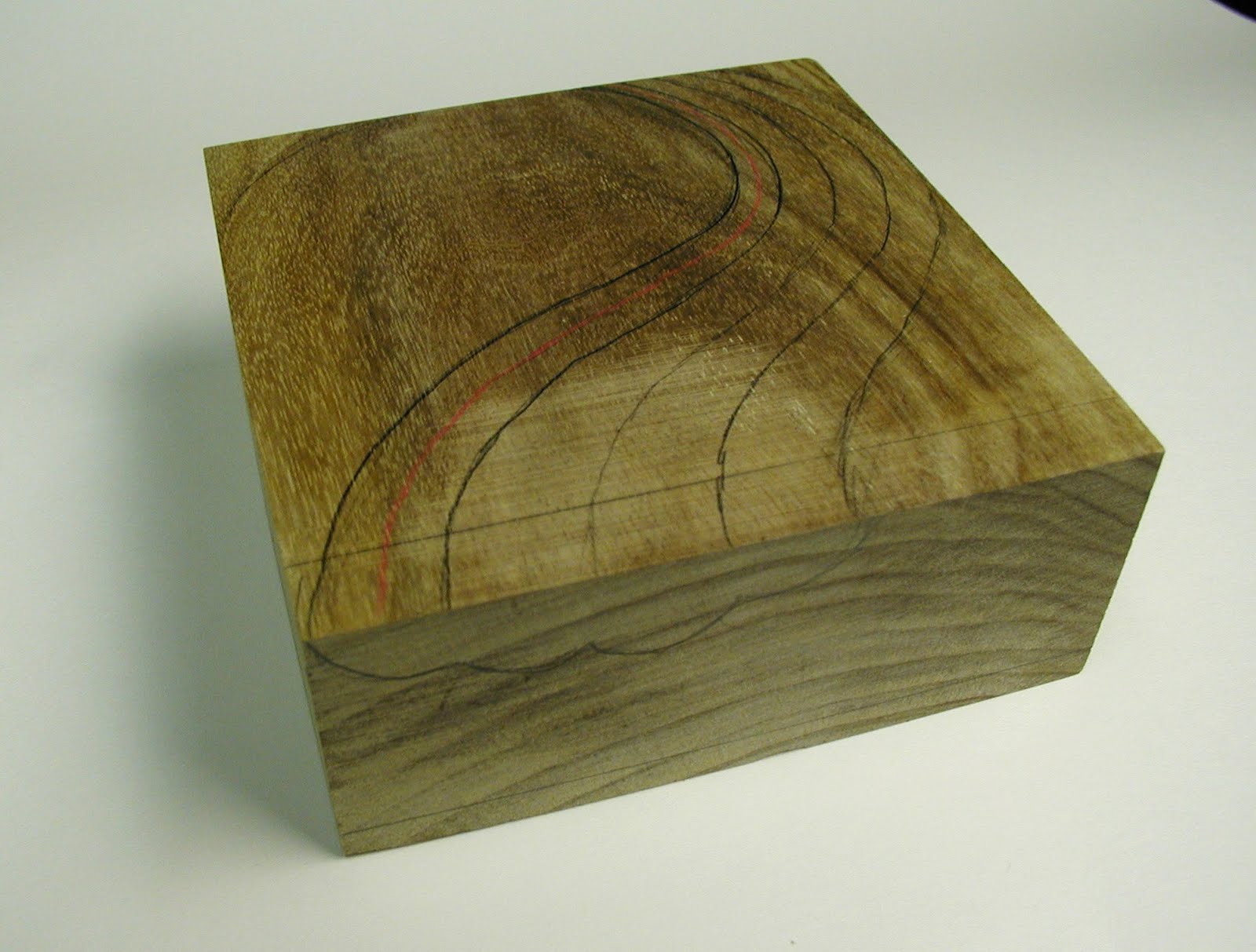
As promised, here are instructions, photos and tips that follow my work on the Molten Wood band saw box made from a chunk of canary wood.

I purchased this slab of canary wood about 6 years ago from a bargain table at Woodcraft. I've been waiting for the right project. The first step is to draw the design on the wood.


I used power carving tools to get the deep wave grooves. A round bur works best. Start coarse and work to fine.


Rough shape of the wave grooves completed. It's time to go to the band saw.


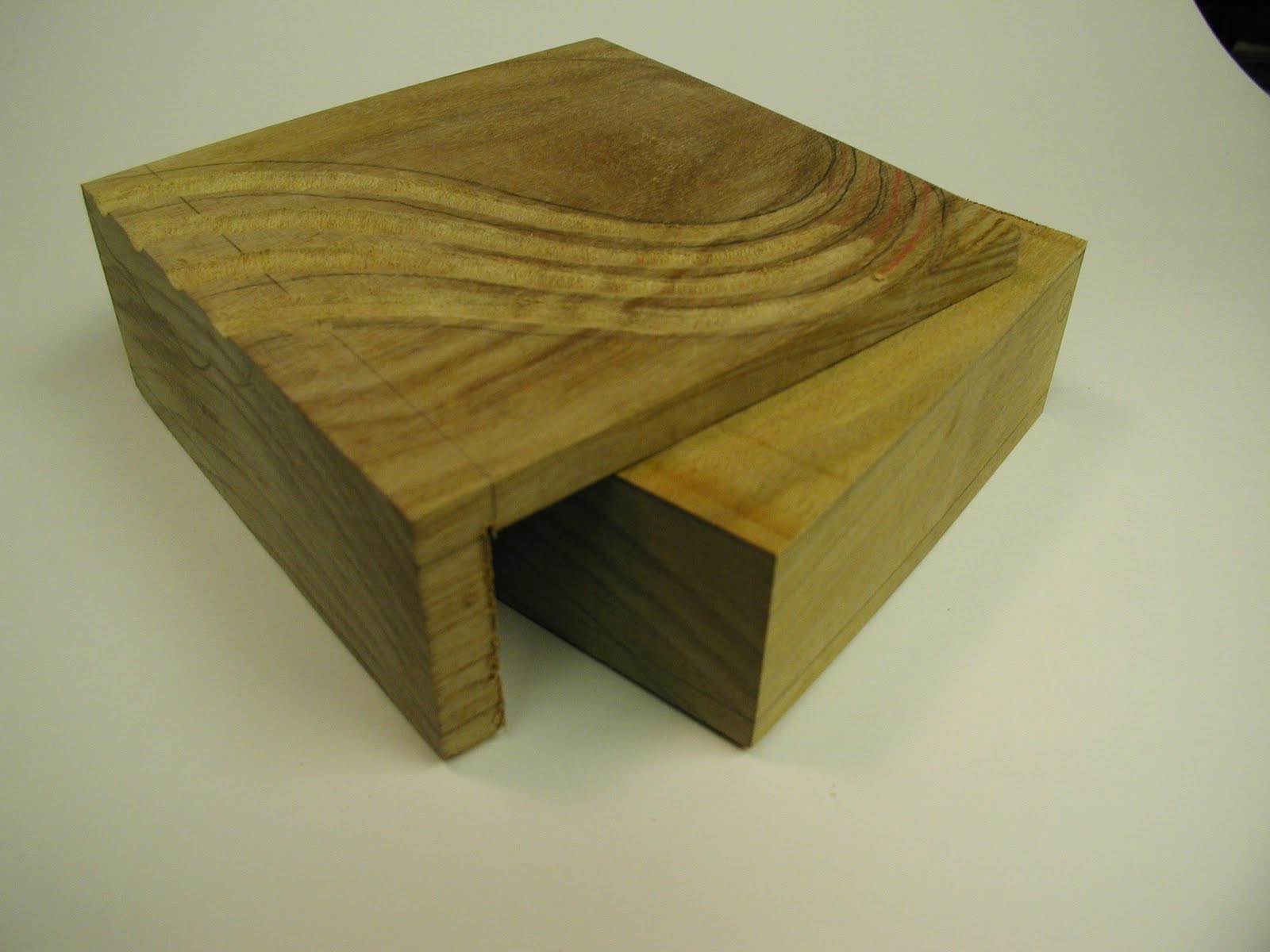
Here's where it gets a little tricky. Instead of just sawing off the top of the box like you would in making a normal band saw box, you saw up to a marked point and then saw at 90 degrees to that line to create the overhang.


Next, use the band saw to cut out the overhang shape. This is hard to explain, but it is probably obvious to any woodworker.


Here's the way the overhang looks after sawing. As you can see, I cut a little too far into the first wave. This will have to be fixed up later.


Now, cut off the bottom as you would normally do when making a band saw box.


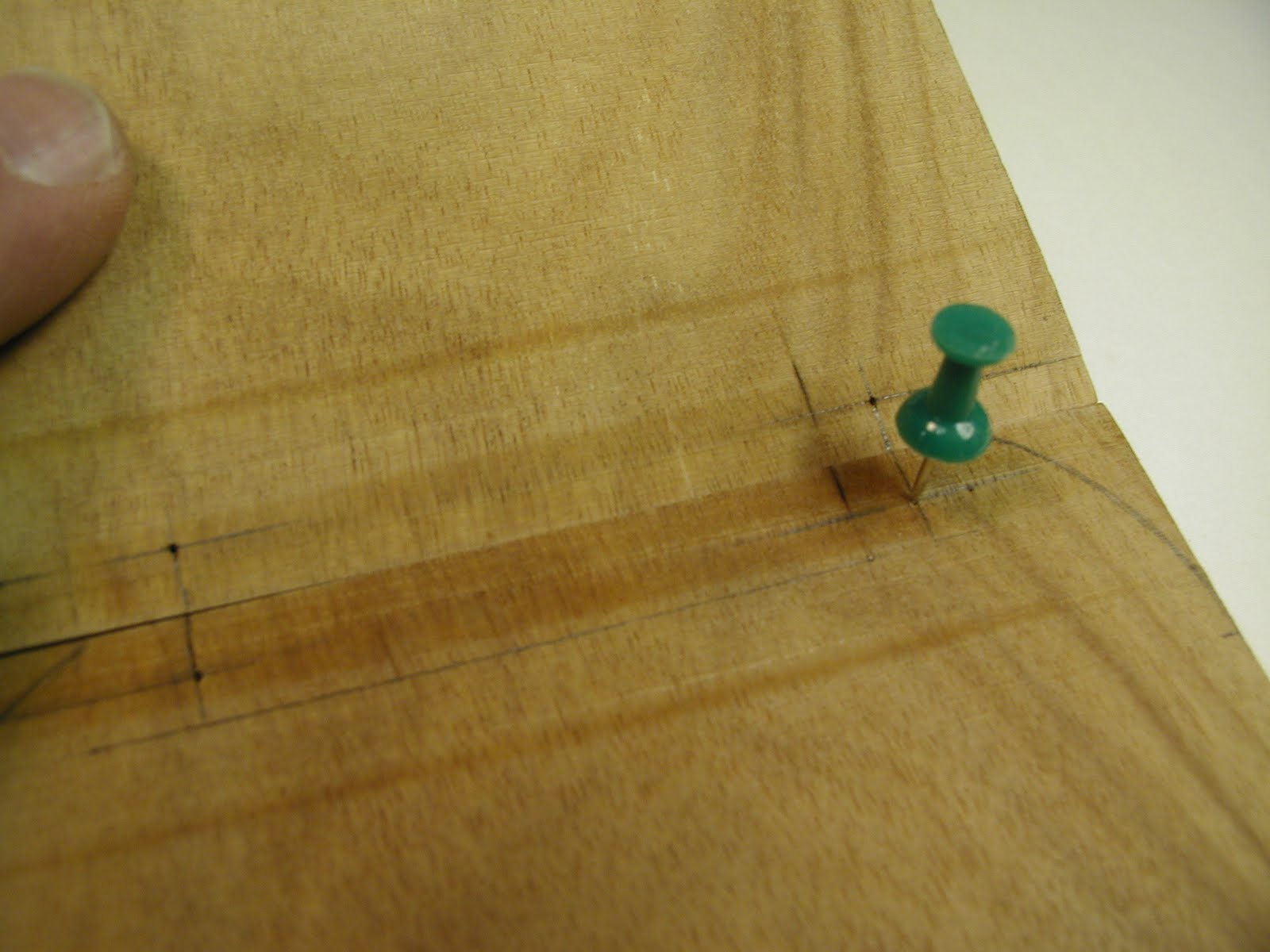
The trickiest part of making this box is getting the barrel hinges to align perfectly. If they are off by even one millimeter, the box will never open and close properly. Accuracy is essential. Wood crafters have many tricks for getting proper alignment. You can find them on the internet. As for me, I have found that careful measurent and a brad tipped drill bit can get you right on the money. I start by exact measurement lines and precise marking with a push pin to set the exact hole center.


The barrel hinges are cylinders 5 mm in diameter with a hinge pin in the middle. I bought a 5 mm brad point drill bit and I am very pleased with the results.


I clamped the wood loosely on the drill press and then carefully guided the brad tip of the drill bit into the hole made by the push pin. I then clamped it securely and drilled the hole. Since the box top is thin, be careful with the depth of the hole. The objective is to position the tiny center pin shaft of the hinge exactly at the surface of the wood on both the top and the end of the box.


The next step is to make a 45 degree cut in the lid and the base. The angle must intersect the exact middle point of the hinge at the pin so the lid will open correctly. Needless to say, this can be very tricky. Again, precise measurement is very important. Of course experience and a little luck doesn't hurt either. I used my table saw which is set up with a very accurate 45 degree crosscut sled. In the past I have also used my router table. My wood craftsmanship is far from perfect, so I wound up doing some "corrections" work on the belt sande to get everything to work properly. No glue yet. This is just a dry fit at this point to make sure all the parts work.


Up until this point I have been working with a squared off block of wood. It is important to have this "right angle" frame of reference for proper alignment and measurements. Now it's time to add some curves. I cut the outer shape of the box on the band saw.


Here's what the box looks like at this point. Remember, the inside is still solid wood.


Take off the top and bottom and use the band saw again to cut the box interior out of the middle section. I entered near the corner so it would be easier to glue and hide the entry point. The dark lines on the curved corners indicate that I need to change my saw blade. A rubber backed sanding cylinder on my rotary tool will get these marks out without much effort.


Gluing. I use Tightbond II. First glue the center section of the box together at the saw blade entry point. An elastic band clamp works fine for this. Make sure the alignment is exact.


The next step is to glue the bottom to the box side section. Use good clamps for this. Once clamped, I usually lightly sand the outer surface at the glued joint. The fine saw dust will stick to the glue and fill up any voids in the intersection.


Now comes the sanding, and lots of it. Notice how the box lid slightly overhands the side of the box. This is caused by gluing together the kerf void on the perimeter section. One side is now a bit shorter. To the belt sander! At this point I am also still forming the waves on top of the box with power carving burs and rotary sanding tools. Hand gouges were also used. Anything that works and is within reach. I mark areas that need wood taken away with a red pencil. I do this regularly during the forming process. Shape. Stop and take a look. Mark. Shape some more. A lot of patience and a lot of sawdust.


Next, I gave the whole box a light coat of wipe-on polyurethane varnish. In this photo of the back of the box, notice how the 45 degree cut is precisely at the center of the barrel hinge hole. I use epoxy to secure the barrel hinges and open and close the box severall times during the 5 minutes it takes the epoxy to set to make sure the cover sets and opens correctly. After fine sanding, I put a few coats of satin poly varnish on the box as a finish coat.


As any artisan will tell you, you have to know when to stop improving what you have and call the piece "finished". I had a perfect reminder of this on this box. I kept on sanding away on the wave grooves until I sanded right through the wood. Yikes! After hours and hours of work, I now had a hole right in the key focus spot of the piece. A tiny hole, but to me it seemed like you could drive a truck through it. Of course I panicked and thought it was the end of the world. But a little wood filler and some very precise staining and you can hardly notice the flaw. Look at the second groove from the left.


So that's how I made the box. I probably could have included another 8 or 9 photos, but it is very lengthy as it is. I hope these instructions and personal tips will be of help to you. Let me know if they were.

Thursday, December 30, 2010

Winter time is fireplace time.


At Christmas time we had our first fire of the year in our fireplace. I gathered some old wood from outside and also a box of scrap wood from my workshop; the remnants of a variety of projects over the past few months. My 5 year old granddaughter was helping me throw the small scraps on to the roaring fire. Then I realized that she was keeping about every third piece because she liked the way they looked, especially the ruby stains in the box elder. Ah, a girl after my own heart.


Here's an old English poem about firewood:


Beech-wood fires burn bright and clear
If the logs are kept a year;
Store your beech for Christmastide
With new-cut holly laid beside;
Chestnut's only good, they say,
If for years 'tis stored away;
Birch and fir-wood burn too fast
Blaze too bright and do not last;
Flames from larch will shoot up high,
Dangerously the sparks will fly;
But ash-wood green and ash-wood brown
Are fit for a Queen with a golden crown.

Oaken logs, if dry and old,
Keep away the winter's cold;
Poplar gives a bitter smoke,
Fills your eyes and makes you choke;
Elm-wood burns like churchyard mould,
E'en the very flames are cold;
Hawthorn bakes the sweetest bread -
So it is in Ireland said;
Apple-wood will scent the room,
Pear-wood smells like flowers in bloom;
But ash-wood wet and ash-wood dry
A King may warm his slippers by.

Anonymous
Do the dancing flames really symbolize dancing wood nymphs?
Keep the home fires burning brightly this winter.
I wish you all a happy and a peace-filled new year.

Tuesday, November 30, 2010

Herbie's Auction

I’ve always been fascinated by trees with names, but we’ll talk more about that some other time. Right now I want to focus on one specific tree by the name of “Herbie”. Herbie was a 217 year old elm tree, and held the official title of the biggest elm tree in New England. It towered 110 feet above Yarmouth, Maine. It was about 8 feet in diameter at the widest point. Herbie died from Dutch elm disease. The only reason Herbie lived as long as he did was because of the loving care of Yarmouth’s tree warden, Frank Knight, who cared for the tree for over 50 years. Frank is 102 years old himself. I’m not making this up folks. It’s a great story.

Herbie had to be cut down in February of 2010. That in itself was no simple task. We’re talking about over 40 tons of wood, and about 6,000 board feet of usable lumber.

If you read this blog, you know I believe there is something special about these old trees. You also must know that I believe that the spirit of the tree is, in some way, reincarnated in the beautiful and useful objects that are made from their wood. The good news is that even though Herbie the tree may be gone, he is still alive in his wood. When Herbie came down, Chris Becksvoort, a New Gloucester furniture maker found himself in charge of the wood distribution. He had the great idea of letting artisans and craftsmen use the wood from Herbie to create objects that could be auctioned off. The auction would raise money for the Arbor Fund of Falmouth to plant new trees. He got his idea from the Onetree Project in England where artisans did the same thing with a 170 year old oak tree that was dying and had to be cut down.


Over 80 artisans and artists participated creating over 300 objects for the auction. Objects included benches, tables, carvings, lamps, bowls, vases and an electric guitar. There was even a mobile made from paper from Herbie. The auction was held two weeks ago and netted $25,000 for the arbor fund. Click on the links to see an article on the auction and a video of a news report on the entire story.


This is the guitar made from Herbie wood by Andrew Olsen of AO Guitars.


These turned and carved vases were made by Jacques Veresy.

Reclaiming the wood from any old tree is a great idea but I think that using the wood from an important historical tree is very special. Apparantly The people at Historical Woods of America agree with me. Visit there website and find out more.


Have you ever crafted something out of wood from a special old tree?