Showing posts with label woodworking. Show all posts

Wednesday, May 13, 2015

Selling Woodcraft Items on Etsy


About two years ago I started selling some of my creations on Etsy.com.  If you are not familiar with Etsy, it is a website that offers crafters and artisans a virtual shop of your own to sell your items.  Actually, I have two shops on Etsy. The first is called the Firebird Cigar Box Transformation Studio, or Firebird Box Studio for short.  In this shop I sell repurposed wooden cigar boxes. I use the empty cigar boxes as a medium for my creativity by carving or pyrography or collage.  I have been making these boxes for many years now and they were accumulating in my basement.  My shop on Etsy gives me the opportunity to sell some of my accumulation without the hassle of setting up a booth and selling them at a craft fair. 

I stared the second Etsy shop last month.  It is called “Cast with Wood”.  In it I sell all my other crafted wooden items that are not repurposed cigar boxes.  Most of what I sell in this shop are hand crafted wooden boxes.  I’m not trying to earn a living from these shops, just a little spending money.  (Actually, most of the proceeds go back into tools and supplies.)

If your wooden craft creations are starting to take up too much space in your house, even after you’ve given gifts to all your family and friends, maybe you should consider Etsy. It really works.  But before you jump in, here are a few tips based on my personal experience.
Tip #1 – Browse around Etsy first

Before you set up your shop on Etsy, take some time to browse around.  Search for items similar to the ones you will be selling.  Notice how the seller describe the items and present them.  See what they are charging and what they add for shipping.  Notice the quality of the photographs they use.  Think of a possible name for your shop and see if it has already been used or if there are similar shop names that might get confused with your shop.  Figure out ways to distinguish your shop from the competition, to make it stand out.
Tip #2 – Begin with the end in mind

This tip is straight out of Stephen R. Covey’s famous book: “The Seven Habits of HighlyEffective People”.  Before you start writing a description of any item you plan to put into your shop, look at the item and figure out how you are going to ship it.  Actually, your very first step would be to purchase a postage scale if you don’t already have one.  Once you know the weight and the size you can investigate shipping options.  Will you use the United Stated Postal Service, or UPS, or FedEx?  If USPS, will you ship Priority Mail or regular mail?  Do you have a box to fit the item, or will you use a standard USPS box?  Do you have packing material?   Will you charge the purchaser the exact shipping cost, or will you add an amount for handling?  You get the picture. 
Tip #3 – Take good quality photos

If you are not good at taking good quality photos, get the help of a friend.  I think it is extremely important to present you items as professionally as possible.  In browsing through Etsy, you will quickly notice the shops that use good photography verses the ones that take a quick iPhone shot on the dining room table. Use a background cloth. (Felt or fleece fabric works fine.) Show you items in natural light.  Show close-up details.  Etsy allows you 5 photos per item.  Use all five.
A carved wooden cigar box I sold on Etsy
Tip #4 – Get organized

Use an excel spreadsheet to keep track of every item listed and every purchase.  Set up your own system.  Number each item. If you are not comfortable with Excel, do it by hand on a ledger sheet.  Etsy is good at keeping track of your sales, but it is a good idea to keep your own records so you can personalize them.  If you think that you will only be selling a few items so you don’t need organization and records, you will have a rude awakening.  Things get confused rather quickly.  If you are not organized your efforts will result in problems, not enjoyment.
Tip #5 – Don’t price too low

This is a common mistake for crafters.  Don’t price your turned wooden bowl to compete with the mass-produced turned wooden salad bowl from some sweat shop in Asia, on sale at Wal-Mart.  The things you make with your own hands are valuable, one-of-a-kind works of art and should be priced as such.  People scan Etsy looking for unique crafted item for that special gift.  They are seldom looking for the cheapest item, but rather the best item for their needs. They appreciate your work and craftsmanship and are willing to pay for it.

Tip #6 – Treat the buyer like they are royalty
I’m suggesting you go beyond merely thinking “the customer is always right”.  I believe you must treat them with extra special attention.  Your goal should be to make them happy with their purchase.  Thank them often.  Include a personalized form letter or note with the shipment, and maybe add a short handwritten line.  The making of some of the items I have sold were actually described on this bog.  I pointed that out to the buyer.  It's all part of the personal connection.  There is a practical motive for this customer rapport: positive feedback comments on you Etsy site.  When a buyer takes the time to write a nice comment, it is certainly very valuable for influencing potential future buyers.

Give Etsy a try.  It is a rewarding feeling when someone sees the value in your work and is willing to pay you money to posess the item you created. 


Saturday, August 30, 2014

C. F. Martin & Co. Guitars - Fine Wood Craftsmanship in America


I visited the C. F. Martin & Co. guitar manufacturing plant in Nazareth, PA and took the factory tour. I was very impressed and also very surprised.  For some dumb reason I had expected to see a tiny woodshop with talented luthiers using hand tools, producing a few guitars a day.  Martin Guitar certainly has talented luthiers using hand tools, many with over 30 years of experience; but this all takes place within a humongous factory that uses modern production machinery to produce several hundred guitars per day.  Sure, they use laser cutting of the wood and robots for the final sanding and polishing, but the important woodcraft, all fitting and forming, is still done proudly by hand.
I observed one craftsperson fitting the guitar neck into the body. To me, it looked like a nice tight fit, but it was obviously not up to Martin Guitar standards, or her own personal standards as a luthier.  She tapped the neck out and used a very sharp chisel to shave a tiny, paper-thin slice from each side surface. She then gave it another dry fitting before gluing. It was now perfect.  It makes me feel good to see that exacting wood craftsmanship can still exist in such a high production environment.


The guitar tops are almost always made of spruce.  The sides and back of the guitars is where the “wow” factor comes in.   Martin Guitar uses beautifully grained hardwoods like walnut, tiger maple, mahogany, sapale and rosewood.  Just gorgeous.


Many of Martin guitars are custom made and have special mother of pearl inlays.  Laser assisted, but the final inlay and fitting work is all done by hand.

 
If you are a serious guitar player, the Martin Guitar factory with its spectacular guitar museum is like Mecca to Moslems or Vatican City to Catholics.  I don’t have to tell you about it.  You’ve probably been there already.  If you are a wood crafter or love objects made from wood, I would recommend that you go out of your way to visit this place and take the tour.  It’s very impressive.
 

Tuesday, January 14, 2014

Bandsaw Box for Storing Flies

 
I love fly fishing.  I enjoy standing in the stream and feeling nature surround me.  I enjoy the challenge of trying to make a perfect cast where the fly line just rolls out to exactly where you want the fly to land.  I enjoy watching the pattern of the water flowing over the rocks.  Someone once told me that, at times, a trout will actually get snagged on the sharp little hook attached to the fly at the end of your line.  I think he was making it up.  I never catch any fish.  But I do enjoy the experience. 

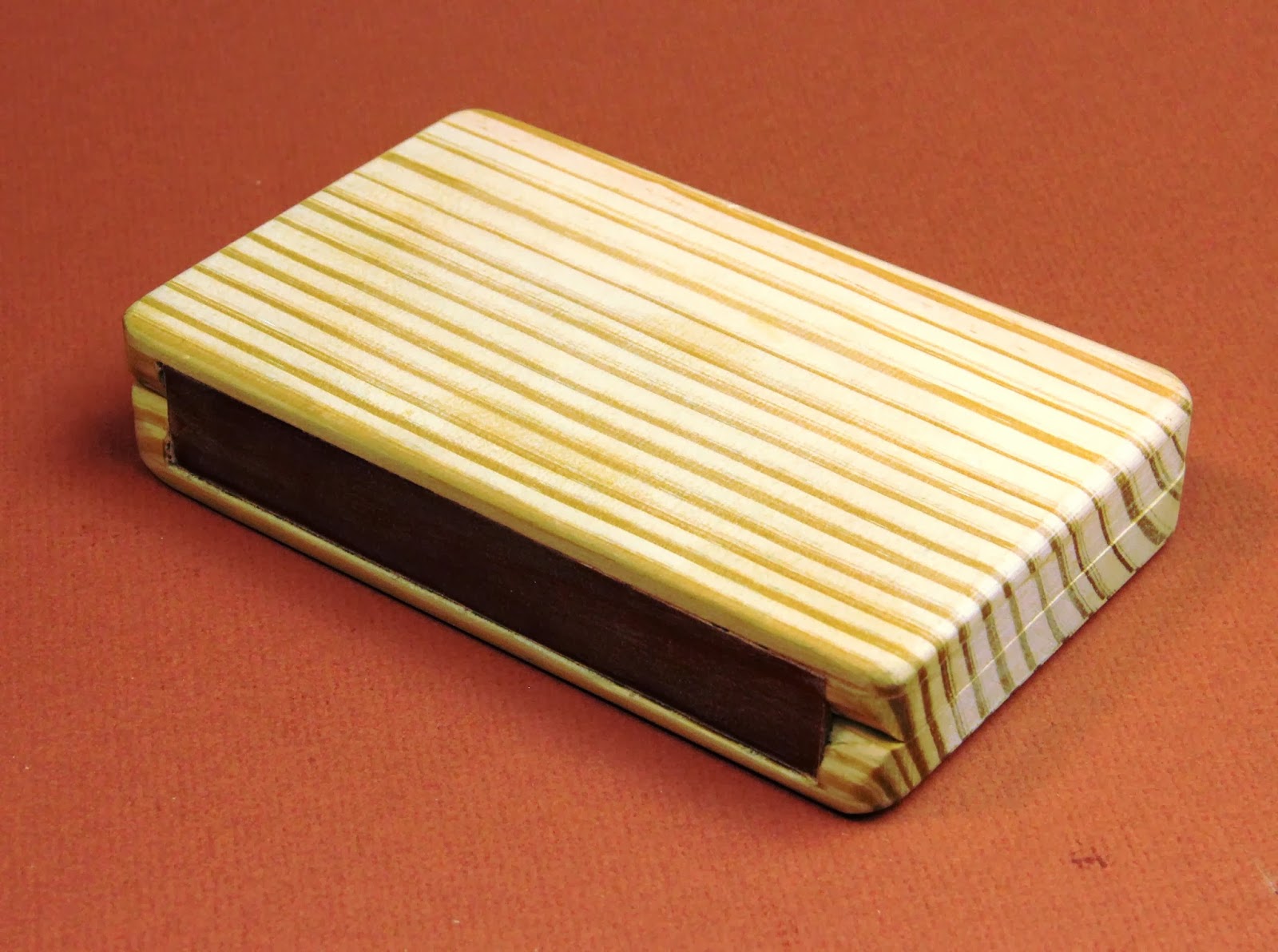
I got an idea to make a fly storage box using band saw box techniques.  I could use magnets for closure, but what could I use for a hinge?  All of the hand-made wooden fly boxes I found on the internet used brass hinges.  They required extra thickness of the wood and, from my experience, were difficult to set perfectly on small boxes.  I got the idea of using a thin leather strip as the hinge.  It was all trial and error from that point, so I made a prototype out of 2x6 pine.  I know nothing about leather, so I made a trip to my local Tandy Leather store, which proved to be very helpful.  I picked out about $2 worth of leather from the scrap bin, which will probably be enough for my next 20 projects ;-).  The clerk/leather expert also recommended a small bottle of neatsfoot oil, which is used to make leather very soft and flexible.  I was not aware of this magic oil, but apparently any serious baseball player with a mitt is very familiar with it.  I used epoxy to adhere the leather hinge strip to the wood.  After a few adjustments, I got the hinge to work just fine.  Here are some photos showing steps in the process.  If anyone else out there has had any experiences with leather box hinges, I would love to hear about them.

A router was used to cut out the groove for the leather
hinge strip, before the box was sawn into two halves.
The leather was 0.07 " thick.
 
The leather hinge strips were glued on using a strong epoxy. 
The photo shows the leather strip being clamped during glueing.
A scrap of wood was used to provide even pressure.

A prototype was made out of a common 2x6 to test glueing
method and clearances.  I found that a thin strip of masking
tape down the middle of the hinge kept it free from epoxy
so it remained more flexible..

Neatsfoot oil was liberally placed on the leather hinge strip
using a cotton swab.  This provided even more flexibility.

This photo shows the leather hinge flexing

The finished products.  I made one from walnut
and the other from spalted silver maple. 


Friday, November 1, 2013

Rick’s Knife Handle

 
My son-in-law Rick brought me a beautiful steel knife blade with tang, and a piece of buckeye burl wood, and he asked me if I would make him a knife handle.  I couldn’t say “no”.  He must have thought that just because I make things out of wood, I would automatically know how to make a knife handle.  Wrong.  I’ve never done this before.  If he had asked me to whittle a stick in the shape of a knife, I would have used trial and error until I got it right, but with one expensive blade and one fancy piece of wood, I knew I would only get one single shot at doing it right.  Thanks Rick.  I really needed the stress.

Well the bottom line is that, like so many things in life, I created stress where there was no reason for stress.  The task was actually not as difficult as I had first imagined.  As a first step, I searched the internet (and more specifically YouTube), for information on how to attach pieces of wood to the knife tang and make a handle out of it.  As you might imagine, it’s all there.  Also, as you might imagine, there are a number of different approaches or techniques.  Most of the techniques use epoxy to hold the wood handle parts to the metal tang, and that’s the direction I took.  Of course, you have to use metal pins to hold the whole thing together, but with the use of the epoxy, there is no need to peen the pins to secure the wooden halves as you might expect. I used some common sense and left some exposed wood in all directions for sanding.  Even though I normally hate sanding most wooden objects I make, I have to admit that sanding and shaping the knife handle was actually fun.  My stationary belt sander was quite useful in the shaping.
   

I wrapped the blade and the exposed metal in duct tape
to protect the finish, and my hands.
During the shaping on the belt sander,
I scraped the metal on the handle.
This came out with steel wool and buffing.
I used tung oil for the
finish, and fine sanded
between each coat to get a
very smooth result.


Of course I couldn’t just hand him the knife, so I fixed up one of my flat cigar boxes as sort of a “presentation box”.  I must admit, I was pretty proud of the final result.  Now that I am an “expert” at making knife handles, I’m starting to look into knife kits on the internet.  Have any of you had any experiences with making knife handles?  If so, I would love to hear about them.

The finished knife in a presentation box

Wednesday, August 8, 2012

Carving Japanese Crests on Old Cigar Boxes

In my search for interesting symbols to carve on recycled wooden cigar boxes, I discovered Japanese crests. These crests, also called mon, or in the case of family crests, kamon, have been an important element in Japanese design for centuries. Their history and usage throughout the ages is an interesting subject. I will not go into the history in this posting, but you can do your own research on the internet. The crest symbols were originally used by the samurai and powerful warlord families. Today they are used primarily as decorative symbols for fabrics, tattoos, and corporate logos. The three diamond Mitsubishi logo for example, seen on all their vehicles, is actually the family crest. It symbolically represents three water chestnuts.


I started by getting a good reference book which shows hundreds of Japanese crest patterns and variations. Certain designs are perfect for carving; others are not. Some crests, even though very beautiful, are just too detailed and intricate to carve in wood. Some crests are very dramatic and impressive; others are rather mundane.

Most representations of the mon symbols are seen as two dimensional impressions on paper, fabric or skin. Carving them into wood presented some problems with proportions and spacing because of the depth dimension and sloped edges. Also, in the two dimensional representations, there is almost always an important contrast of positive and negative spaces…usually dark printing on a light background. Showing this contrast in uniformly colored wood required some added steps. I wound up using dark background stains and pyrography.

Despite these challenges, I was able to find a few crest designs that seemed to lend themselves to carving on the top of a wooden box. Three are shown in the photo above. Have you ever used Japanese crests in your work?

Thursday, June 14, 2012

The Back Porch Project

I have not posted on this blog for quite some time now. There are a number of reasons for this, one of which is spring. Spring always brings an abundance of thing to do, mostly outdoors and away from my workshop. There is yard clean-up, planting and lawn maintenance. I haven’t been doing any small woodworking projects; instead I have been totally consumed by one big one. I built a new wooden back porch.

In simple terms, the porch is a platform with two steps. I could have worked in simple rectangular shapes, but no, I had to get complicated. My design had 45 degree angles and had to fit in over the existing porch which was a crooked, sinking concrete monolith. I even built a cardboard model to get the approval of the “authority having jurisdiction”, namely, my wife. I also had to draft fairly detailed plans since many of the measurements had to be precise.

Before

This project took a long time to complete, far longer than I had imagined. A good friend of mine told me that when you have a project like this, you should figure out how much time it will take to finish it; then double the estimate…then multiply by ten. He was not far from wrong.

The end result is not perfect, but it is functional and looks good. I learned a few things from this project. First, I learned that words like “level” and “square”, which I always thought were absolutes, turn out to be suggested goals. I learned that driver screws and metal corner brackets result in an unbelievably strong construction. The porch could probably support an elephant. I learned that wet wood shrinks after it dries. This should not have been a surprise to a wood person like me, but I learned the hard way. The 1/8” gaps between the decking boards are now ¼” gaps. Finally, I learned not to be a perfectionist.

  
After

Sunday, December 11, 2011

Colorful Carved Coffins of Ghana

http://www.ghana-net.com/fantasy-coffins-of-ghana---fantasie-saerge-in-ghana
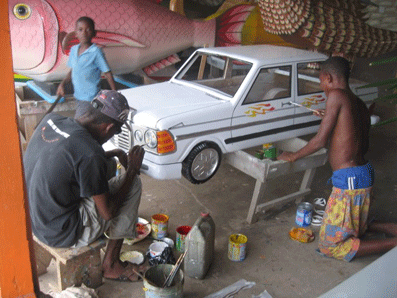
In one of my previous posts, I talked about wood carving in Ghana.  There is another important expression of wood craftsmanship in Ghana that should also be mentioned.  I’m talking about hand-crafted wooden burial coffins, in the shape of everything from a Coke bottle to a Mercedes.  This colorful art form is unique to Ghana.

For most tribal cultures in Ghana, especially the Ga people from around Accra, funerals are not only a time of mourning, but also a time of celebration.  They can last a week with food and music and every relative and friend in attendance.  The people believe that their departed loved one is moving to another life, and they make sure they do it in style.

In the 1960’s a creative carpenter named Seth Kane Kwei started making custom designed fantasy coffins which were called Abebuu adekai (" boxes with proverbs ") by Ga people.  The concept became very popular and the construction of these coffins is still carried on today by relatives and former apprentices of Kwei in a number of wood shops scattered around southern Ghana.  The coffins are designed to represent an important aspect of the deceased person’s life.  It may be a taxi cab, if the person was a driver; or a fish if the person was a fisherman.  It may be symbolize the person’s hobby, pet or even a vice like a bottle of beer or a cigarette. 


The coffins are custom-made and can take up to three weeks to complete.  During that time the deceased person is kept in a refrigerated morgue.  Most coffins are usually made from a light, inexpensive wood such as wawa or alstonia boonei (cheese wood).


These special coffins are works of art, built by skilled carpenters; designed and finished by talented wood artists. Unlike many works of wood art that remain visible for centuries; these wood creations are buried with the deceased, never to be seen again. It is truly art for the moment, transitory art, like Tibetan Buddhist sand paintings. Each coffin is returned to the same earth that nourished the original tree which gave the wood to build the coffin. The cycle is complete.


The concept of hand-worked wood returning to the earth is the same for any wooden coffin, whether it is Ghana or an old cemetery here in the United States. The wood decays in the ground and a new tree grows, but the skill of the wood craftsman remains constant through all generations.


Not Ghana, but the Moravian Cemetery, Bethlehem, PA


Saturday, November 26, 2011

Good Wood

Alpha Box
cherry, redwood lace burl, and mahogany trim
If you have been reading my blog, you must realize that most of the wood I use in my creations is found wood. The old silver maple tree that was cut down in the back yard several years ago has provided many spalted maple boxes and spoons. The apple tree provided a nice walking stick. And the trunk of the huge old cedar shrub was cut into pieces for many different projects. Call me cheap, but I hardly ever spend money to buy "good wood".

During last year’s excursion to a woodworking expo, I was tempted by a wood vendor with beautiful wood for sale. I succumbed to the temptation and purchased some good wood.  I bought some nice cherry planks and a small, expensive piece of redwood lace burl. I planned on making my first constructed box using those power tools in my workshop that make very loud intimidating whining sounds. I’m talking about the table saw and the router table. These tools demand a certain respect since they can change your anatomy and send you to the emergency room in the blink of an eye. Up until now I have been using less harmful tools, like a small band saw, a drill press and carving gouges. These tools also require careful use, but they are nowhere near as fearful as the hungry rotating blade of the table saw.

I read books on box making, and I used some of the suggestions in the books, but as usual, I found my own ways of doing things. I took my time, and measured carefully. I’m pretty pleased with the result, which I named the Alpha Box. Of course there are several small flaws that are probably hardly noticeable to most people, but seem very obvious to me.

I learned that I still have a lot yet to learn about finishing wood. I learned that setting the hinges takes more time than building the pyramids. And I learned spending some money on good wood really improves the overall look of even my first attempt at a constructed box.

Wednesday, September 21, 2011

Mass Production...sort of


I’ve been selective is scavenging empty wooden cigar boxes at my local cigar emporium. One particular brand of cigars comes in boxes that are made from thick sapele wood. The tops are extra thick and ideal for carving. I decided the size of the box would make a great tea bag caddy. I carved the top in an Oriental fashion with the Chinese (also Japanese) symbol for tea. I was pretty pleased with the result, but there were a few things I thought I could improve upon if I did another one. Then I thought, since I have more of the same size cigar boxes, why not make two more. It was an experiment in mass production on a small scale.

Perhaps I could make lots of these tea bag caddies and sell them at craft shows, or give them away as gifts. I hear stories of other artisans who make many pieces of the same design and give them away. One ambitious person actually made several hundred small band saw boxes; one for every guest at his daughter’s wedding.

The result of my experiment was that I came to the realization that mass production is not for me. For one thing, carving boxes does not lend itself to mass production. It’s not like baking cookies or making a jar of peach jam for each of your relatives and friends. Other than using the same design, there is no economy of scale in carving since there are just as many wood chips removed no matter how many boxes you carve.

Even if there was a time benefit, I just don’t like making the same thing over and over again. I like to experiment with new approaches and different techniques. After I made the second tea bag caddy, the third one really became a chore. As I was making it I was thinking of all the other creations in my head that I could be making instead of this duplicate. I guess I’ll just stick to individual pieces.


Monday, May 9, 2011

Musical Wood in the Woods

You know I like clever things made out of wood. You know I like forests. You know I like music.  Well, this video obviously rates very high on my "like" list.  It's totally amazing.  Enjoy.


You can see the full width version at:  http://www.flixxy.com/musical-wood.htm 

Tuesday, April 26, 2011

Spirit in the Wood

“…The tree, which is used for the body of the drum, contains a living spirit. Great care is taken to make sure that the wood of the drum is alive.” 
from: “The Beat of My Drum: An Autobiography” by Babatunde Olatunji

Ask my family. Most of my adult life I have wanted a hand drum. That might seen to be an unusual desire coming from a retired white guy in the suburbs, but it was an itch that just wouldn’t go away. At first I thought I wanted a conga drum. Then I attended a drum circle where they had an assortment of African drums to use for the evening. Most of the drums were djembes, the familiar West African style drum, but a few were different. They were taller, had a slightly different shape and a much deeper, richer sound. They are called bougarabou, a bit of onomatopoeia, since the drum name is the sound it makes (bou-gara-bou). I immediately knew what type of drum I wanted. It was a perfect fit for my baritone soul.


Last week I finally got my drum. I love it. I bought it from a shop called “Spirit in the Wood”. With a name like that, how could I do otherwise? Spirit in the Wood is a small, one-man operation. That man is Conrad Kubiak, a professional drummer, drum teacher and drum maker. Conrad is an interesting character. He may be a reincarnation of Leonardo DaVinci. He works out of a small house with detached garage/workshop, on a small road in rural Bucks County, PA. There is no sign and most people would just pass it by. Most people, yes, but any person who works with wood would notice the collection of hefty log sections sitting in his driveway, especially since half of them have large, interesting-looking burls on them, waiting to be turned into works of art.


There is no doubt that Conrad is a wood craftsman. Just like all other wood turners, Conrad has a lathe. The only difference is that while some turners make pens, Conrad makes conga drums. He turns his own drum shells on a monster industrial lathe that must be 100 years old, and takes up half of his workshop. He has personally developed special tooling and techniques that sets his craft apart.

Sure he makes high quality drums out of fine hardwoods, but if you look closely on the dusty shelves you will also fine beautiful bowls turned out of burl and fine crafted wooden boxes that will be magnificent, if he ever gets to finish them. Conrad knows drums, and he also knows wood.


My bougarabou drum


I bought my drum from Conrad, but not one of his hand-crafted works of art. Since this is my "beginner’s” drum, I bought one that was hand carved out of iroko wood by a craftsman in the Ivory Coast, a genuine West African drum. But who knows? If I get good, maybe I’ll upgrade to one of his eye-popping cherry wood originals.

Saturday, April 9, 2011

The Look, Touch and Smell of Wood

I remember visiting Duckloe Furniture in Portland, PA several months ago. They have exquisite examples of American hand-crafted furniture. Their showroom is filled with everything from Arts and Crafts and Shaker styles to Windsor Chairs that they have been making themselves for over 150 years. The woods and grain patterns are awesome. Words like bird’s eye, tiger, quarter-sawn and burl are used a lot in the wood descriptions of the items on display.

Like a naughty child, I found myself touching everything. As I ran my hand across the top of a table or over the carved decorations I realized how much I love to touch wood. There is a tactile sensation that brings me joy. The smoothness of the finish, the beauty of the grain pattern, even the smell of the beeswax and oil, all contribute to my sensual enjoyment.


I get a similar feeling in my own workshop. It may be the fine sawdust that remains in the pores of your hand after sanding; or feeling the contour of a piece you just carved. I’m sure many of you fellow woodworkers know what I mean. I remember finishing a spoon with wax and mineral oil and then sitting watching TV and just rubbing the finish with my bare hands for quite some time. It was a comforting sensation. You may argue that velvet or leather also gives tactile pleasure, but when it comes to hard materials, nothing beats wood.


I just completed my Salamander Cane. It was my first attempt in carving a critter wrapped around the cane. Instead of carving a detailed snake with hundreds of tiny scales like the award-winning artist, Dave Stehly, I chose a much simpler piece for my first attempt. The salamander is a lot smaller and its skin is smooth and easy to carve. I liked the feel of the wooden cane handle. I realized why canes and walking sticks are made of wood. For some reason, it just seems natural.


Has working with wood heightened your sensual awareness?


Wednesday, January 12, 2011

The Good, the Bad, and the Ugly


As I mentioned in a previous post, I have been experimenting with creating things out of old cigar boxes. I’ve been using carving, pyrography and decoupage to transform these old wooden boxes into interesting works of art. The photo above shows a “good” result: a jewelry box for my daughter made from beautiful sapele wood with a nice thick top for carving. Unfortunately, on some other attempts I ran into problems. I’m glad the boxes are inexpensive, because a lot of them wind up on the scrap wood pile. Most of them are made to look exquisite in the cigar store, but a closer inspection shows their flaws. Here are some of the problems I have found working with recycled wooden cigar boxes. I hope you an learn from my experiences and save yourself some grief.

Severe Warping – Cigars demand a moisture rich environment. The wood for the box is probably newly cut and very moist. The air in the cigar store is kept humid. Then you bring the empty wooden box home to an atmosphere that is very dry by comparison. The result is severe warpage. See the photo below. Beautiful wood…nice box shape…but totally useless.

Laminated Wood and MDF – Some boxes are painted or stained. You sand of the finish only to find medium density fiberboard or cheap plywood. Bummer! The plywood is also a prime candidate for warping.
Label Removal – Otherwise known as a time-consuming exercise in screaming and cursing. Why is it that the nicest looking boxes have labels attached with glue that could be used to build steel bridges? Forget water as a solvent. Try paint thinner or mineral spirits. I even tried acetone. The label came off, and so did the finish. Because the labels are so hard to remove, you can easily scrape the surface if you are not careful. Labels on the inside of the cover are especially troublesome to remove. They are usually very colorful and foil coated. I tend to leave them on as reminder of the fact that the finished box was a cigar box at one time.
Cheap Hardware – Don’t expect the hinges and clasps to be top quality. In some cases, you might want to replace them with better hardware.
As a result of all this, I have become pickier at the cigar box bin. I now know what brands of cigar have the best boxes to work with. I still enjoy recycling these old ladies into beautiful maidens.

Tuesday, November 30, 2010

Herbie's Auction

I’ve always been fascinated by trees with names, but we’ll talk more about that some other time. Right now I want to focus on one specific tree by the name of “Herbie”. Herbie was a 217 year old elm tree, and held the official title of the biggest elm tree in New England. It towered 110 feet above Yarmouth, Maine. It was about 8 feet in diameter at the widest point. Herbie died from Dutch elm disease. The only reason Herbie lived as long as he did was because of the loving care of Yarmouth’s tree warden, Frank Knight, who cared for the tree for over 50 years. Frank is 102 years old himself. I’m not making this up folks. It’s a great story.

Herbie had to be cut down in February of 2010. That in itself was no simple task. We’re talking about over 40 tons of wood, and about 6,000 board feet of usable lumber.

If you read this blog, you know I believe there is something special about these old trees. You also must know that I believe that the spirit of the tree is, in some way, reincarnated in the beautiful and useful objects that are made from their wood. The good news is that even though Herbie the tree may be gone, he is still alive in his wood. When Herbie came down, Chris Becksvoort, a New Gloucester furniture maker found himself in charge of the wood distribution. He had the great idea of letting artisans and craftsmen use the wood from Herbie to create objects that could be auctioned off. The auction would raise money for the Arbor Fund of Falmouth to plant new trees. He got his idea from the Onetree Project in England where artisans did the same thing with a 170 year old oak tree that was dying and had to be cut down.


Over 80 artisans and artists participated creating over 300 objects for the auction. Objects included benches, tables, carvings, lamps, bowls, vases and an electric guitar. There was even a mobile made from paper from Herbie. The auction was held two weeks ago and netted $25,000 for the arbor fund. Click on the links to see an article on the auction and a video of a news report on the entire story.


This is the guitar made from Herbie wood by Andrew Olsen of AO Guitars.


These turned and carved vases were made by Jacques Veresy.

Reclaiming the wood from any old tree is a great idea but I think that using the wood from an important historical tree is very special. Apparantly The people at Historical Woods of America agree with me. Visit there website and find out more.


Have you ever crafted something out of wood from a special old tree?

Monday, September 27, 2010

Ah, the burn of a good cigar... box, that is.

I picture one of my early ancestors, thousands of years ago, forging a metal spear point out of bronze and laying the hot metal object down on a piece of wood. “Hey, would ya look at that!” he would say, as the hot metal spear point burned a design into the wood. Thus, the art of wood burning or pyrography was born.

As crude as that early experience might have been, my recent experiences have not been much better. I have taken up the art of pyrography, which means I have invested in a decent burner transformer unit, a few tips of assorted shapes and a tip holder pen. I’m just a beginner, and still in the experimentation stage, but I’m starting to really enjoy this new hobby.

I am very fortunate to have a cigar superstore about 5 miles from my house. They sell empty wooden cigar boxes for one dollar each, ten for $6.00. There are sitting in a huge crate right near the entrance to the store, which doesn’t seem to stay full very long. I’ve been stocking up on boxes for several months now. Some of these boxes are very well made out of solid exotic woods with beautifully crafted box joint corners. Why do I feel like I’ve just given away my secret? Oh well, there are lots of boxes to go around.


This new interest of mine combines art with recycling, which makes me feel good about the enterprise in general. I’m still not sure what I will be doing with the finished boxes, but Christmas is coming up and they might make good gifts.

Have you ever tried pyrography? Have you ever tried to turn old cigar boxes into new works of art?

Thursday, April 29, 2010

These are for the birds

Spring is here so I built a few birdhouses. Actually I built one new one and refurbished two others, all with scrap wood. Admittedly, they are not much to look at, but they meet all the latest recommended birdhouse dimensions and include all the latest recommended features. I’m not sure the birds care how the outside of their houses look.

There are some interesting things to consider when building a birdhouse. For instance, the size of the entrance hole and height above the floor of the birdhouse is very important to appeal to the right species of bird. Also, the popular perch stick is just below the entrance hole is not needed, nor recommended. It provides a place for predators to sit and wait. Another feature to prevent hungry squirrels from chewing through the hole area is to reinforce the hole with a ¾” thick block of wood, making the entrance passage longer. All the specifications and suggestions you will need are on the internet. If you are interested, go to the following websites: http://www.wild-bird-watching.com/Building_Bird_Houses.html. or http://baltimorebirdclub.org/by/house.html

After I finished hanging the birdhouses on nearby trees, I got to thinking maybe birdhouses are an opportunity to get creative. As long as all the proper dimensions and features are included, and the birds don’t really care what the house looks like, why not carve something on the front. Perhaps a wood spirit or something humorous. Here’s a challenge: Design a clever birdhouse and send me a photo of it. I’ll publish the best ones on the blog.

Sunday, April 11, 2010

"A Reverence for Wood" by Eric Sloane


What books do you keep on the nightstand near your bed or on the shelf next to your favorite chair? Those books (and magazines) probably say a lot about who you are and what is important to you. The subtitle of this blog, “a reverence for wood”, was not chosen casually. One of the five or six favorite books on my nightstand is “A Reverence for Wood” by Eric Sloane, originally published in 1965. Actually, the book I have is called “Sketches of America Past” and combines two other Sloane books, “Diary of an Early American Boy” and “A Museum of Early American Tools” along with “A Reverence for Wood”, in a single bound edition.

I first read “A Reverence for Wood” back in the early 1970’s and remember being totally captivated by it. I have re-read it many times since then. It’s my kind of book, lots of interesting illustrations, all by Eric Sloane himself. It is also a historical book about “the old ways” of making practical things out of wood. It shows that our ancestors had close relationship and intimate understanding of wood that, for the most part, has been lost by our present generation. It is a book about history and the ingenuity of the early American pioneers. It has definitely been an influence on my life and my pursuit of woodcraft.

I was not going to post this entry on my blog since I couldn’t imagine my blog visitors, most of who are interested in woodworking, as not having already read “A Reverence for Wood”. It is practically required reading for anyone interested in wood. But then I thought perhaps there are people out there, especially visitors from other parts of the world, who may never have heard of the book. But even if you have read the book before, it is worth getting a copy and going through it again. Every time I open it, it gives me a new incentive to go make something out of wood.

Have you read “A Reverence for Wood”? What are your thoughts about the book, or other books by Eric Sloane?